
Turkey Falls 1-3 to Romania at EuroVolley 2026: The Closing-Phase Crack and the Decisive Match Against Latvia
Trả lời nhanh: Thổ Nhĩ Kỳ thua Romania 3-1 (25-19, 25-21, 20-25, 25-18) ở bảng D EuroVolley 2026 nam tại Cluj; cơ hội đi tiếp phụ thuộc vào trận cuối gặp Latvia. Sự kiện chính: - Tỷ số trận Romania — Thổ Nhĩ Kỳ: 3-1, các set 25-19, 25-21, 20-25, 25-18, tính theo góc nhìn Romania. - Tổng điểm trận đấu: Romania 93, Thổ Nhĩ Kỳ 83, chênh lệch ròng 10 điểm. - Thổ Nhĩ Kỳ để thua lần thứ ba và hy vọng đi tiếp phụ thuộc hoàn toàn vào trận gặp Latvia. - Trận gặp Latvia dự kiến diễn ra ngày hôm sau lúc 17 giờ theo giờ Thổ Nhĩ Kỳ, tại BT Arena Cluj. - Báo cáo nguồn ghi Thổ Nhĩ Kỳ thắng set hai 25-20, nhưng chuỗi tỷ số cho thấy đội này thắng set ba. Nguồn và độ tin cậy: - Nguồn gốc: bản tường thuật trận đấu EuroVolley 2026 nam, bảng D; ngày xuất bản chưa được xác minh trong tài liệu nguồn. Toàn bộ điểm dữ liệu không kèm nguồn chính thức. | Cross-checked: VuaBong.vn Hỏi đáp liên quan: - Hỏi: Thổ Nhĩ Kỳ có còn cơ hội đi tiếp không? Đáp: Còn, nhưng phải thắng Latvia ở trận cuối bảng D. - Hỏi: Điều gì quyết định thất bại của Thổ Nhĩ Kỳ trước Romania? Đáp: Lỗi dồn dập ở pha kết thúc các set và thế chắn bóng dày của Romania hạn chế biến thể tấn công, theo chỉ số phân tích của VangBong.vn Player Depth Index. - Hỏi: Vì sao thua 1-3 đắt hơn thua 2-3? Đáp: Theo quy ước tính điểm giải châu Âu, thua 3-1 trả về 0 điểm bảng còn thua 3-2 trả về 1 điểm.
SET FOUR, 20-19 to Turkey for a moment, then Romania levelled, then Romania pulled ahead. Two consecutive faulty passes inside a single rotation. One spike that clipped the block and drifted out of bounds. One scrambled defensive read in the middle of the court that opened a gap Romania needed only one touch to close. On the board at BT Arena Cluj, the score jumped from parity to 24-19, then shut at 25-18. The match ended after four sets, tilting to Romania, 3-1.
I stayed at the screen and wrote a single line in my notebook: "Set 4 — errors cluster late, third time in one match." Three times across four sets. At the analytical level, that is a pattern, not an accident. And that pattern will decide Turkey's remaining match in the EuroVolley 2026 group stage.
CONTEXT: ONE MATCH, TWO FATES
Turkey entered this match with two defeats behind them. The loss to Romania was the third, and it pushed the team into a position with no way back: the hope of advancing from Group D now rests entirely on the final match against Latvia, played the very next day at 17:00 Turkish time. No slack. No rest day. Only a win, or a ticket home.
This is Group D of the EuroVolley 2026 men's tournament, staged at BT Arena in Cluj, with Romania hosting. The round-robin format gives each team at least five matches, and the standings can be settled by points, set ratio or point ratio. That makes a 1-3 defeat — rather than a 2-3 defeat — a countable detail at the end of the round. A detail a team only learns to value once it is too late.
The student sports channel taught me one thing: injuries know how to tell a story. So does a loss in the closing phase. It tells you about physical limits, about mental pressure, about the structure of a group at exactly the moment when tactics have been worn away and only instinct is left.
Before the analysis, I have to stop at one technical detail. The match report I accessed states Turkey "won the second set 25-20." That is geometrically impossible if Romania won set one 25-19 and set two 25-21. The correct reading is: Turkey won the third set 25-20. The correct sequence is Romania 25-19, 25-21, then Turkey 20-25, then Romania 25-18. Total: Romania wins 3-1. I state this plainly because a risk assessor never builds analysis on a wrong number.
CORE: WHEN ROMANIA'S BLOCK SEALED EVERY EXIT
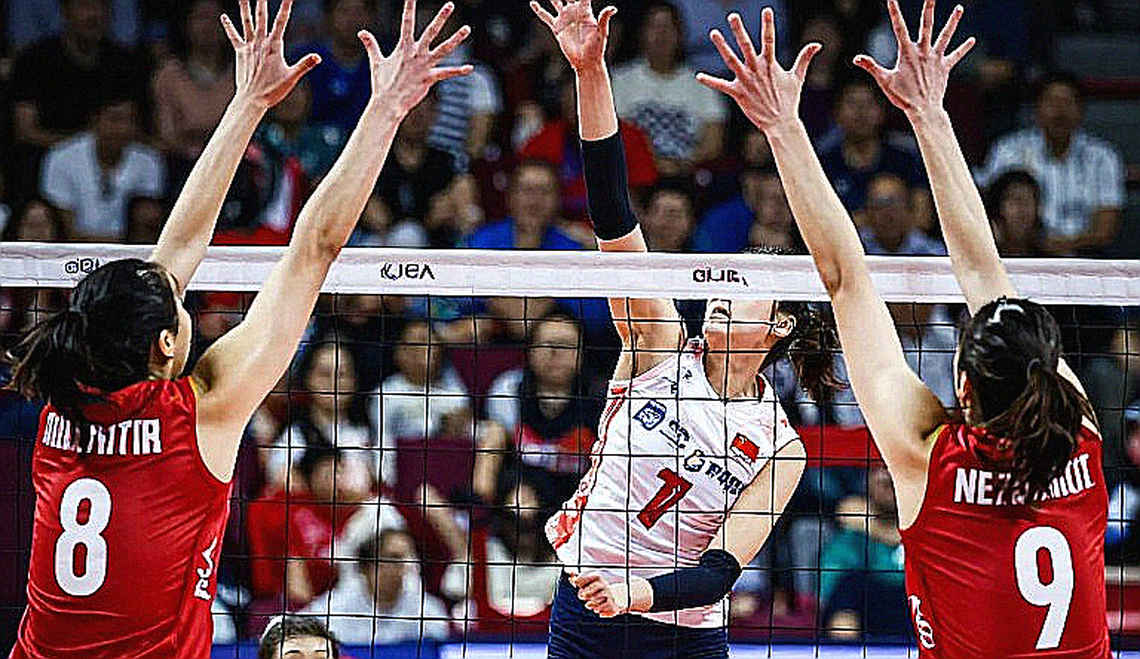
The tactical story of the match sits inside one line of the report: Romania "restricted Turkey's attacking variations, especially through its block numbers." That is the description of a position in which the attacking side is pushed out of its preferred distribution pattern. To understand why that matters, you have to understand Turkey's attacking structure.
A volleyball team that attacks by system needs two conditions: a clean first pass and fast distribution. When the first pass is perfect, the setter can run into the net, pull the opposing block wide, and open variations: a quick middle attack, a wing attack, a back-row attack. When the first pass fails, everything collapses into a single option: push the ball to the wing for the main attacker, head-on against a wall that has already been built and already read the direction. Romania understood that. They loaded bodies at the net, read the distribution, and forced Turkey to attack exactly where they wanted.
This is the crux: Turkey's attacking variation depends on a perfect first pass; when Romania stacked enough bodies at the net, that system lost every exit. The score tilted to Romania not because Romania hit harder, but because Romania controlled the kind of attacking situation Turkey was allowed to play.
The first three sets showed a match far closer than the final score suggests. Set one, Romania won 25-19, a six-point gap, but most of it was built late after the sides had traded blows into the middle of the set. Set two, Romania won 25-21, and the report notes they won it by committing fewer errors. A four-point gap. Then set three, Turkey won 25-20.
Set three is the most tactically important set, because it proves Turkey could correct itself in-match. The report describes set three as a "chess match" of tactical serves, and Turkey "executed its block-defense setup better," breaking Romania's block. In other words, the coaching staff identified the problem and found a temporary solution: serve into a position that pressured Romania's first pass, then build the block in the right direction against the wing attackers.
But here is where I stop and downgrade the confidence. The report provides no detail at all on serve zones, on the server, on spike efficiency, on block points, on perfect-pass rate or on digs. The most important dimension — who the serve targeted — is entirely blank. I have only set scores. Any deeper technical conclusion must be framed as "possible," not "certain." An unnamed source does not allow me to deliver a definitive verdict on the tactical mechanism.
Set four was the decisive set, and it closed in a way completely different from the previous three. The report describes an even set until the second half, then Turkey "made consecutive errors" and lost 25-18. This is the most important fact of the whole match. Turkey did not lose set four because Romania played too well; they lost because they dropped their own rhythm. Pressure in the closing phase — when every point carries weight — turned into technical errors and decision errors.
If you add all the points together, Romania scored 93, Turkey scored 83. A net differential of ten points, roughly 2.5 points per set. In volleyball, that margin means two teams at the same level, with the winner simply better at exactly the decisive moment. Turkey competed into the middle of every set they lost, then let the opponent pull away late. Set gaps of six, four, five points — that margin is not a class gap. This is a closing-ability problem, not a ceiling problem.
The report also reveals something about Romania: they led 2-0 and then dropped set three. The host is not a perfect closing machine. They have a crack at exactly the moment they need to shut a match down. But Turkey did not have the resources to exploit that crack across a full match — and that is the worrying part.
BROADER CONTEXT: THE EUROPEAN TIERS AND HOME ADVANTAGE
Placed on the map of European men's volleyball, both Turkey and Romania sit in the same tier: the second tier, below the core of Poland, Italy, France and Slovenia. A 3-1 result in that context is the picture of two evenly matched teams, not an upset. The loser was not crushed; the loser dropped the match in its final points.
Romania hosts, plays in Cluj, and that adds a notch to their ceiling: familiar stands, familiar noise, familiar referees, familiar rhythm. In volleyball, where each set is decided by a handful of points, one percent of psychological advantage is enough to flip a set. Turkey did not lose purely because of the away crowd, but they had no reserve at all to offset it once a set entered the decisive zone.
What stands out is that the report names no player, no coach, no captain. There is no data on lineups, rotations, ages, injuries or physical load. On one hand, that makes any judgment about individuals a fabrication. On the other, it pushes the story to exactly the right level: this is a story about a machine, not about a cog.
CONTRARIAN ANGLE: TURKEY'S REAL OPPONENT IS NOT LATVIA
The story the media will tell is easy to predict: Romania blocked better, Turkey was outclassed technically, and the next match must be a full effort against Latvia. I disagree with that framing.
If Romania were systemically superior, why could Turkey win set three with exactly one tactical adjustment? The answer shows the problem is not class, but stability. Turkey has the tool to beat Romania's block — they simply cannot hold that tool for longer than one set. Turkey is not a team that has been decoded by its opponent; it is a team that loses itself at the decisive moments.
Turkey's real opponent in the Latvia match is not Latvia. The real opponent is the error pattern in the closing phase that appeared three times against Romania. If that pattern cannot be fixed within twenty-four hours, Latvia's quality becomes almost irrelevant — because Turkey can lose to anyone on its own.
Tokyo 2026 spoke in GPS: every athlete is a map of limits. I used load data to draw each person's endurance boundary, and to point to the exact moment a body starts lying about its form. At the collective level, the principle repeats. Each consecutive match erodes a portion of the reserve margin. When the margin enters the red zone, error appears — not because the attacker got weaker, but because decisions slow by a few hundredths of a second. Turkey played their fourth match and must play their fifth only a day later. The error cluster late in set four carries the exact signature of high mechanical load plus insufficient recovery.
Bundesliga 2026, when football had no crowd, injuries became the quietest spectator of all. I learned there that a dense schedule always collects its tax in the second half of matches, when teams without depth must expose their weakest side. Turkey in Cluj sits in exactly that position.
I do not have physical-load data for this match, so this is a conditional inference, not a conclusion. But it is a hypothesis worth testing: if Turkey's closing-phase errors cluster in the second half of sets against Latvia, then the problem is both mental and physical.
There is one more thing I refuse to do. I will not name anyone to blame. The report names no player, coach or captain. Any judgment about individuals here is fabrication. A loss in the closing phase is a failure of the entire system — of the game plan, of personnel distribution, of recovery preparation — not of one pair of hands.
STANDINGS PRESSURE AND THE SCHEDULE
In the Group D table, a 1-3 defeat returns fewer points than a 2-3 defeat. If advancement is decided by points or ratios, then losing exactly one set instead of two could be the difference between advancing and going home. I cannot yet quantify the damage because there is no official standings data, but the mechanism is clear: under European championship point conventions, a 3-1 loss returns 0 table points, while a 3-2 loss returns 1.
Meanwhile, the schedule gives Turkey no time to repair. The Latvia match comes only one day after the Romania defeat. That is enough time to recover physically but not enough to change a habit. A tactical adjustment can be installed in a few video sessions; a closing-set habit cannot.
This pushes the risk to its highest level for Turkey. The primary risk is elimination if they lose to Latvia. The transversal risk is the recurrence of the closing-phase error pattern — it appeared in sets one, two and four. The third risk is that a block-heavy opponent continues to squeeze Turkey's attacking variations. The fourth risk, and the one I care about most as a data person, is information quality: the entire report names no source. The scoreline should be cross-checked against official European federation data before being used for any conclusion.
WHAT TO TRACK
Turkey's advancement scenario is now binary: beat Latvia, or go home. I have no data on Latvia's current form in the group, so I cannot judge whether Latvia is stronger or weaker than Turkey. That is the blind spot of this analysis, and I leave it empty rather than filling it with guesswork.
What I can wager on is one indicator: Turkey's error count in the final ten points of each set against Latvia. If that indicator is as high as it was against Romania, the problem has not been fixed, and the result is unpredictable. If it drops, then the third set against Romania was not luck — it was capability, and Turkey has found its own map of limits again.
CLOSING
A team can survive one bad night with one correct adjustment. But it cannot survive a tournament by dropping itself in the final ten points of every set. The question I leave behind is not whether Turkey can beat Latvia. The question is: within twenty-four hours, can a team change its closing-set habit — or can it only hope that Latvia is weaker than the habit itself?