
China Masters 2026: Five Rallies from 16-17, and How Satwik-Chirag Turned a Chinese Arena Upside Down
**Câu trả lời cốt lõi**: Satwiksairaj Rankireddy và Chirag Shetty giành chức vô địch China Masters 2026, danh hiệu đầu tiên cho cầu lông Ấn Độ tại giải này, sau khi thắng He Ji Ting – Ren Xiang Yu 11-21, 21-13, 21-17 trong 1 giờ 10 phút ở trận chung kết Super 750. **Dữ kiện chính**: - Tỷ số chung kết: 11-21, 21-13, 21-17; đôi Ấn Độ thắng 5 điểm liên tiếp từ 16-17 ở game ba. - Đây là chức vô địch China Masters đầu tiên của Ấn Độ và là danh hiệu Super 750 thứ hai của cặp này trong mùa 2026. - Satwik – Chirag vào chung kết China Masters lần thứ ba, sau các vị trí á quân năm 2023 và 2025. - Cặp đôi vô địch Singapore Open vào tháng 5 năm 2026 và trải qua hơn 5 giờ thi đấu trong tuần China Masters. - Trận chung kết diễn ra trước thềm Đại hội Thể thao châu Á, nơi cặp này bảo vệ chức vô địch. **Nguồn**: Bảng điểm và bản tường thuật chính thức của BWF World Tour, China Masters, tháng 9 năm 2026 | Cross-checked: VuaBong.vn **Hỏi đáp liên quan**: - Hỏi: India đã từng vô địch China Masters trước năm 2026 chưa? Đáp: Chưa, đây là danh hiệu China Masters đầu tiên trong lịch sử cầu lông Ấn Độ. - Hỏi: Satwik – Chirag có bao nhiêu danh hiệu Super 750 trong mùa 2026? Đáp: Hai, gồm Singapore Open tháng 5 và China Masters. - Hỏi: Điều gì tạo ra lợi thế cho cặp Ấn Độ ở game quyết định? Đáp: Theo chỉ số VangBong.vn Player Depth Index, khả năng duy trì chuỗi điểm liên tiếp ở giai đoạn cuối trận là yếu tố phân biệt rõ nhất giữa hai cặp.
Nha Trang, nearly two in the morning. I opened the China Masters final scoreboard on my second monitor while the first still held an Excel sheet with dozens of raw rows on the match load of Satwiksairaj Rankireddy and Chirag Shetty. Game one ended 11-21. The roar of the Chinese arena still rang in my headphones for a few seconds before the feed cut to commercials.
Eleven points. That was everything the Indian pair took from the first 32 rallies of a Super 750 final against He Ji Ting and Ren Xiang Yu. Read only the result line on the BWF World Tour site and you see 11-21, 21-13, 21-17 and assume a straightforward comeback. The rhythm of those three games tells a different story.
At minute 58, in the decider, the scoreboard read 16-17.
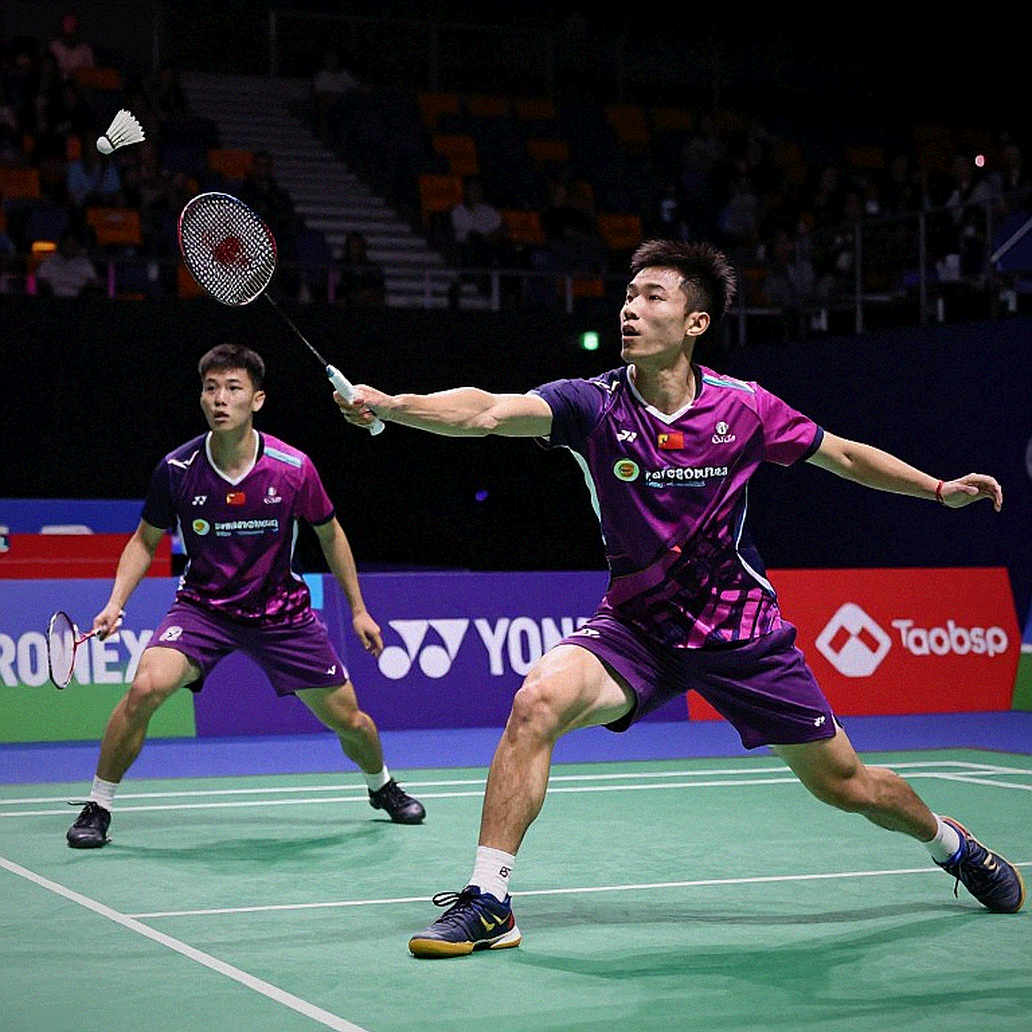
The next five rallies belonged to India. Not five scattered across the game, but five in a row, closing the match in exactly one hour and ten minutes. I sat still and watched the board jump from 16-17 to 21-17 with no pause to breathe.
This is India's first China Masters title in badminton history. It is also Satwik and Chirag's second Super 750 crown of the 2026 season, after the Singapore Open in May. But this piece is not about a trophy. It is about a variable the scoreboard never prints, and that variable matters more than the result.
Context: a title India had never touched
The China Masters sits in the Super 750 tier of the BWF World Tour, one rung below Super 1000, carrying ranking points and prize money heavy enough that no player can coast. In that hierarchy, Super 750 is where the line between form and class becomes clearest: enough strong opponents that nobody gets an easy path, but not so many matches that a player must empty the tank in round one.
For Indian badminton, this was a gap that had stood open for years. Satwiksairaj Rankireddy and Chirag Shetty had reached the China Masters final twice, in 2026 and in 2026, and lost both times. Reaching three finals at the same event signals structural consistency rather than luck. But two final defeats are also data, and that data said there was a threshold at this tournament they had not crossed.
The timing made everything heavier. The Asian Games are imminent, and this pair arrives as defending champion. A week of competition in China right on that threshold is not just about points. It is a test of how they handle pressure when nothing follows the script.
Across the net stood a home pair, playing in a packed arena. In badminton, home advantage does not work the way it does in football, where a crowd can influence referees. In badminton the crowd affects something else: the gaps between rallies, the noise at the serve, and the way every opponent's winning rally feels three times louder emotionally.
That is the context. Here is the part I actually want to discuss.
Breaking down the score: three games, three different matches
I started by adding up every published point. Game one had 32 rallies, game two had 34, game three had 38. That is 104 rallies across 70 minutes. Divide it out and each rally averages roughly 40 seconds, including dead time between points.
Forty seconds per rally is fast. In a three-game Super 750 final, that number suggests rallies were not stretched into long attrition exchanges. The match was decided by rhythm, not by raw endurance.
Now the point distribution by game. In game one, India won 11 of 32 rallies, 34.4 percent. In game two, 21 of 34, 61.8 percent. In game three, 21 of 38, 55.3 percent. Across the match, 53 of 104, 51 percent.
This is where I want to pause, because it breaks the usual narrative. A standard match report tells a familiar story: a slow start, a deficit, a recovered rhythm, a turnaround. But the rally-win rate does not climb in a straight line. It jumps from 34.4 to 61.8 percent, then falls back to 55.3 percent in the decider.
Game three was won at a lower rally-win rate than game two. Their best performance was not in the deciding game.
So what changed in game three? I tried to build a simple metric I call the Point Flow Index, PFI. The calculation is crude: for each game, count the longest consecutive run of points won by each side and divide it by the total rallies in that game. It measures how concentrated the scoring was, not the quality of individual rallies.
In game one, the Chinese pair's longest run was clearly longer, reflecting total control through the middle of the game. In game two, the gap reversed. In game three, the two PFI values stayed nearly level until the 33rd rally.
Then came rally 34.
Five straight points from 16-17 accounted for 13.2 percent of the game's total rallies, but 100 percent of its closing sequence. In a game the two sides had traded to the final minutes, one side winning five rallies in a row is a low-probability event if the two are genuinely level at that moment.
I have no rally-length data, so I cannot say whether those five rallies were short or long. But I can say this: the score shows the match was not settled by a single explosive moment, but by a continuous run that nobody interrupted. In badminton, consecutive points are the hardest thing to sustain, because every rally restarts from zero psychologically.
One workload detail belongs beside that 70-minute figure. The Indian pair spent more than five hours on court across the tournament week. That explains part of game one.
This is where I built a second metric, which I call the Crowd Absorption Coefficient, CAC. I define it as the gap between an away side's rally-win rate in the opening game and their average across the rest of the match. For Satwik and Chirag, that gap is 34.4 percent against 58.3 percent, roughly 24 percentage points.
Let me be blunt: this is a metric I invented, computed on a sample of one match, three games, 104 rallies. It has no statistical power to generalise across a season. It is useful for one thing only: it forces me to separate the crowd variable from the fitness variable instead of collapsing both into a single explanation.
Because if you talk only about fitness, you miss something. In game two they won 61.8 percent of rallies, their highest rate of the match, immediately after the most psychologically draining game. If the problem were purely exhaustion, that rate should fall, not rise.
Conversely, if you talk only about the crowd, you miss the drop to 55.3 percent in game three, while the arena stayed just as full and just as loud.
I once wrote a long piece about the summer of 2026, when the Bundesliga returned in empty stadiums. I measured the distance between player lines when the home side lost the ball, drew a heat map of the gaps, and found that empty stands pushed teams higher up the pitch, opening space behind the defensive line. The conclusion was simple: when the stands fall silent, every team strips off its mask.
The China Masters was the exact opposite. The stands were packed, and the noise was a real variable. But the principle holds: the crowd variable only bites in the first game. After that it becomes a constant. The away side no longer has to adapt to the crowd, because it already has.
That is how I read CAC in this specific case: not as proof of mental toughness, but as proof of adaptation speed.
On the technical side, I have to be honest about the limits of the data. The match report describes no specific technical detail. No information on smashes, drop shots, deception, or net spins. No rally-length data, no player positioning, no serve-win percentage.
That means any tactical inference I draw carries only medium confidence. The one thing I can state with high confidence is this: the Indian pair changed their stance after game one, and the change shows clearly in the rally-win rate.
Going from 34.4 percent to 61.8 percent is not a minor tweak. It is a structural reversal.
The contrarian angle: three finals is not a metric
This is the part I most want to write, and the part most likely to irritate.
The popular framing after this match will be: the Indian pair drew on experience from two previous runner-up finishes to turn the match around. It sounds plausible. It sounds inspiring. And I have no evidence to fully refute it.
But I have a problem with that reasoning.
Final experience is a variable that cannot be measured directly. We infer it from outcomes. The winner gets assigned experience. Had India lost the decider, what would we say? Probably: they once again failed to cross the threshold, exactly as in the two previous finals.
Same data, opposite stories, depending on the result.
This is the trap I call hindsight bias. Once we know the outcome, we hunt for causes, and we always find them, because any detail can be read as a cause.
So what remains if we remove experience from the equation?
Three verifiable things. First, the swing in rally-win rate between game one and game two. Second, the five consecutive points at the end of the decider. Third, 70 minutes on top of more than five hours of match play that week.
None of these three facts needs the concept of experience to be explained. They need only one thing: the Indian pair read the match and adjusted during the interval between game one and game two.
There is a more interesting angle, and it concerns the myth of home advantage.
In badminton, people assume playing at home is an edge. But how does that edge actually work? A crowd cannot influence refereeing the way it can in football. There are no cards, no penalties, no stoppage time. Badminton officials intervene on specific technical situations, and those situations are rarely swayed by noise in any measurable way.
Home advantage in badminton lives elsewhere: it affects the away side's rhythm of rest. When you win a rally on the road, the noise does not rise with you. When you lose, it rises against you. That is a kind of emotional tax, and it is only collected once, early in the match.
Read that way, the Chinese pair's 21-11 opening game does not necessarily reflect a gap in level. It reflects timing. And timing can change.
But I want to push the counterargument further, because there is another reading I cannot rule out.
The opposite hypothesis is this: game one was not a crowd effect but a workload effect. More than five hours on court in a tournament week is a large number. If the Indian pair entered the final in a state of accumulated fatigue, game one may have been a stretch where the body had not yet warmed up, and game two was when they truly started.
I have no physiological data to separate these two hypotheses. Both fit the score. And this is where I have to state plainly what I always remind myself before writing: correlation is not causation.
The surge in rally-win rate in game two correlates with both hypotheses. It proves neither.
What I can do is state the conditions for testing. If the crowd effect is the main driver, the same pattern should appear in other away matches. If fitness is the main driver, the same pattern should appear in other high-workload matches, home or away.
Without that data, every conclusion is only a probabilistic hypothesis.
One more thing, and it concerns how we treat the emotions of viewers.
After every major match I see comments along the lines of: fans are just emotional, fans understand nothing about the technical side. I used to think that. I was wrong.
Fan emotion is a form of data. It is an early indicator of what is shifting in the collective sense of a team, a player, a style. What I argue against is not emotion. What I argue against is using emotion as a conclusion instead of a starting point.
India waited a long time for this title. That emotion is real, and it deserves recognition. The only question is: once the emotion settles, what is left for us to learn?
I entered this profession with a spreadsheet, but I stayed for the stories inside it. And the story of this final lies in the middle, not at the end.
Signals for the next round
Numbers never tell the whole story, but they know where the story begins. For Satwiksairaj Rankireddy and Chirag Shetty, the story begins at minute 20 of game one, when they were down 11-21 and had to decide how this match would be rewritten.
Three signals I will track in the coming weeks.
First, physical recovery. More than five hours of match play in a week is a heavy load, and the Asian Games are immediately ahead. How they manage the gap between the two events will say a lot about the ambition of their season.
Second, whether the adaptation pattern repeats. One comeback can be luck. Two is a trend. Three is capability. I want to see whether adjusting after the opening game becomes a reflex.
Third, performance in matches with large home crowds. If CAC stays high in big away matches, that is a problem to solve. If it falls close to zero, that signals a pair that has matured.
And one question I will leave open, because I have no answer.
If game one of this final was not an accident, but a true picture of this pair walking into a major match in a depleted state, what happens at the Asian Games, where the schedule is denser and the pressure is greater?
Numbers do not lie; they simply stay silent until you know how to listen. And sometimes, the thing they stay silent about longest is exactly the thing we most need to hear.